In March 2020, Mayankita had come to home to accept a consultancy assignment after maternity break. With identification of a Corona positive cases in the office area, the offices got closed and she had to extend her stay to complete the formalities in the coming week. Her periods were due this week and she was scared because she had heard about the untouchability associated with menstruation in her in-law’s home and was not sure how she would handle it. During one of her earlier visits, she had seen one of her sister-in-laws being given ‘haldi (turmeric) and ‘gobar’ (cow dung) to be put in water before taking head bath on getting periods. To avoid going through this herself, she used to plan all her home visits on days she would not menstruate by taking pills and manipulating the cycle. This time she was stuck.
Her dilemma:
Her fears came true and she got her periods. She discussed this with Amuli, the domestic help, who suggested her not to tell anyone. Amuli gave her the confidence that she would quietly help Mayankita with disposal of the sanitary napkins without letting anyone know at home. With the fear of the unknown and her own reactions to the practices she had never experienced in life, Mayankita took a stand and decided not to lie. Someday she had to face it and she decided to tell Maa. The moment she disclosed it to Maa, she could see Maa distancing away from her physically. As expected, she asked Mayankita to take head bath and keep the clothes in a corner of the bathroom itself. She was informed that a ‘dhoba’ (the washerwoman) would come and wash them to make them pure again. She had a bad cough so she requested if she could avoid washing her hair. Maa was considerate and she allowed her to avoid washing hair but asked her to put some water on the hair as a ritual of washing. She was also given another privilege of not bathing in water with ‘haldi and ‘gobar’ in it. In her case she was given just ‘haldi’.
The feeling of being an untouchable:
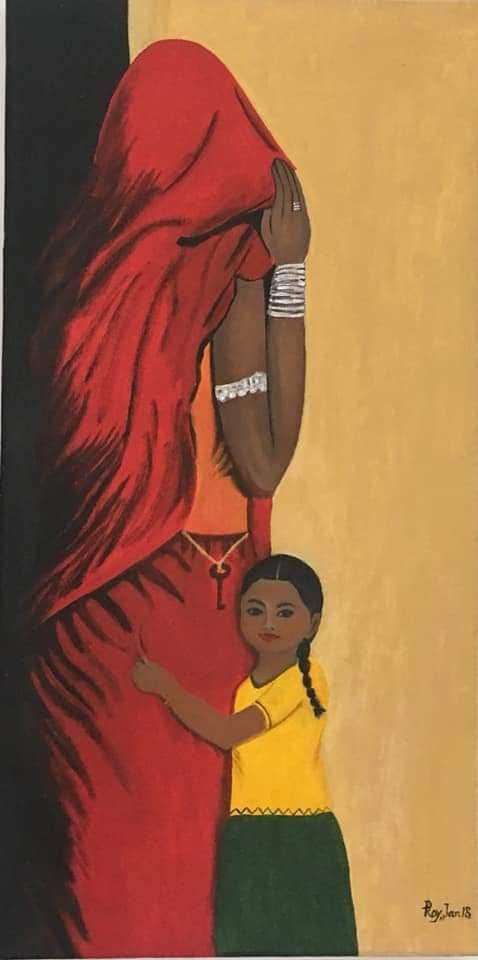
She was confused about her emotional state. She was sad that she was going to be treated like an untouchable for the coming five days; everyone in the family would know that she was menstruating. Never in her life she had faced a situation where she had to tell other members of the family about her periods. She was embarrassed because such systems did not exist in her family or in families of all the friends she had known. The only one restriction she was aware of during periods was—not to worship or visit temples. With the pain of all the emotional conflicts going inside her mind, she took shower, washed her hair and the stained clothes. On seeing her put the clothes for drying Maa showed her annoyance as they were to be left in the bathroom and washed by the ‘dhoba’. No logic worked and despite being washed with one of the best detergents, Mayankita had to leave her saree hanging in the corner room. The next day she found the saree washed by the ‘dhoba’ again for purity sake.
The privileges and the taboos
Now was the time for all the dos and the don’ts—Don’t touch everything; whatever you use or touch during these days will need to be washed by the ‘dhoba’ after five days; clothes will need to be washed by hand (washing machine was barred); don’t enter kitchen or puja room; food will be served, don’t touch food items meant for others; wash your hair on day three (to be able to enter the kitchen) etc. Mayankita was also allowed the privilege of sleeping on the mattress with Shivangi (her two year old daughter) by her side but the empowered and strong woman in her was crying in her heart. All the monsters in her thoughts were laughing loud at her state. Mayankita was running a fever in the night but to avoid creating any unpleasant situation in Mayank’s (her husband) absence, she did whatever she was asked to do.
For the next two days, her movements were restricted; she could feel that her actions were being watched closely. She was aware of the privileges she was being given and the discrimination she had never thought she could live with. She was allowed to have dinner on dining table but the extra ‘roti’ given to her was dropped in her plate before she could directly take it herself; the tea served to her was kept on the floor and not given to her directly from the tray because the person holding tray would become impure. Mayankita could feel the pain of the so called “untouchables” in the society.
The Lost opportunity—family and work:
She had come home to discover the possibility of getting back to work on an assignment that required only ten days of her time in a month onsite. It was also an opportunity for her and Shivangi to spend time with the family every month. But on the third day, with high fever she had to take a head bath to be pure again. In the night, Shivangi came down with a fever. On the day she was to sign the contract, she sent an apology mail. She turned away from a possibly bright future due to the guilt of having risked Shivangi’s well-being to please the significant others of her world.
Perceptions :
Before returning to the city of her stay before the formal lockdown began, she had a brief discussion with Maa about the practices and menstrual taboos. She shared with her that she had ever known about these practices and was not comfortable following them. The explanation given to her was that when a woman is married, she must follow the customs and traditions of the family she is married into (very similar to what Mayankita’s own mother had taught her). That is how women in the family, including the daughters of the family, have been living. This is expected of every daughter-in-law of the family and if they do not follow, Maa would not force them but would certainly be hurt. She shared her wish that she wanted these practices to be followed atleast till she was alive. Maa also educated Mayankita on how strict things were during her times. Maa shared that she was trying to be a liberal mother-in-law by ignoring so many things and allowing privileges that were not available to women in their times or even women at present in the family. Mayankita’s perceptions, however, were pointing towards the deprivation of the rights that she always had. But she very well understood that the socialization of 50+ years would not just go away in a day.
Her choice:
Mayankita knew that when we talk about changing these deeply rooted beliefs and practices, tied with the chains of culture and tradition, it sometimes takes a lifetime. Women in our country are protected by law but realizing them within the four walls of the households comes with the cost of relationships and Mayankita, perhaps, was not courageous enough to do it this time. She never believed in any of the discriminatory practices against anyone based on religion, caste, or sex but to avoid hurting others, she turned away from a possible future. But she was convinced, that someday, someone would take a stand and righteously make the change possible… if not her. Her choice, this time, was to stay away from the family and visit them only in times she was “pure”, as defined by the system. She was sure, she will never allow herself to go through this feeling of being this “untouchable me” ever again.
This cannot be the end of her journey of being a woman. Avoiding cannot be the solution forever and I am sure she’ll learn this soon, fight the battle and come out a winner. I know of another Mayankita who has chosen to break free by learning to say “No” to things she did not believe in. It wasn’t easy; it came with lot of labels for her in the package.She was hurt and had become unforgiving for a while. But she also learned the art of forgiving and letting go of unpleasant memories for a life full of all the significant others in her world. I will certainly share that journey in one of the following blogs.
Reflections:
These practices are deeply rooted in age old norms and customs, created with a purpose, different from the reality of the modern times. Despite the changes in the roles and lifestyles, women are still considered impure during menstruation and are barred from participating in any religious ceremonies, celebrations, not only in the rural part of the country but also in urban families. Women, even in modern times, are treated like untouchables during menstruation; they are not allowed to use mattress/pillows, touch other things that cannot be washed or things that are associated with the concept of ‘purity’ (like Gods, sacred thread, holy books etc). Even mothers and their newborns are untouchables for the initial few days after delivery. While many of these practices may come as a shock to women from different backgrounds, those who do not practice such rituals, may have to go through the experience of being considered impure, or lesser human beings, or looked down upon, and also discriminated against.
It is observed that while both women and men may believe in standing against such norms at the society level, when it comes to their own families, their mothers/parents/families become more important and they give in to such discriminatory demands to avoid hurting their sentiments. The emotional trauma of being treated as an ‘untouchable’ is of no value and the burden of keeping everyone’s sentiments into consideration again lies on the woman herself. It is not easy for her to overcome the fear of being labelled as “bad” (daughter, daughter-in-law, or a bad spouse) and take a stand. It is also not easy for the woman who derives all her powers within the family by following customs and traditions of the family to let go of them in a day and lose all her power and respect. “What will people say” and “will others approve of it” guide her decision to stick to these customs. The onus of the change, therefore, should lie in hands of their male counterparts. Only they can make it possible. They, however, first need to be aware of these silently existing practices within the households.
My next blog will present findings of the study that identified 29 discriminatory beliefs/practices/taboos associated with menstruation and tried to assess the awareness of both women and men on these practices in our society.
“The whole existence of life is based on menstruation among women and if the people born out of such a system are valued, how can the blood be impure and how can the woman who is menstruating be impure?”
I will blesssed..
Like all previous blogs this one is also engaging. Keep this beautiful skill of story telling continue ma’am.
Buaa….this is again…incredible…I have no words…🥺🥺
Felt emotional. It has so subtly dealt with the story of thousands of women. Loved the way it is written.…
The pain of the girl has been brought as if you were living that life…n it’s so odd that love…


Heart touching !
Thank u for your feedback
Perhaps the story of all women born in our era of 70’s and nonetheless prior to it. The current generation is in no mood to hear this considering it more now as a -useless belief’ or andhbiswas the words my niece uses when their grandparents speak of these taboos.
And when they get married into a family that expects them to follow, the psychological eell-being is challenged. I know of girls of 1990s who’re struggling. They will win but why should they face it to begin with? The choice should be theirs..
How beautifully you have scripted the pains Mayankita was undergoing. In towns and amongst educated the willingness to follow such taboos has reduced but in villages there are still so many restrictions…. Developing awareness amongst male to eradicate such customs should be strongly worked upon . Also inculcating strength amongst the younger group to voice against these taboos will give good result. Waiting for your next blog.
Thank you bhabhi. These aren’t realities of villages only. I know of girls in Bhubaneswar and Bengaluru who are expected to follow these norms.. Education and support of male members of the family only can bring the change..
Mayankita – a very evocative name – indeed experiences a much more subdued practice. It’s actually vestigial now, though difficult to say that it’s on the way out. That’s taking nothing away from the sense of degradation, humiliation or debasement she feels. It’s actually an expression of masculine horror at the flowering of female fertility & sexuality. The practice is targeted at the ‘othering’ of the feminine. While the actual practice is almost reduced to symbolic levels in urban contexts (much less so in rural circumstances), the real salvation will lie in true conjugation of the sexes… All the best for the lively narrative.
This is really a great step to express ones feeling, delimma, experiences and disappointments from society, family, near and dear ones. There are many such women waiting for that one day when the things would change, till then they keep connecting to such stories and see their reflections silently… Really proud of you Ranjana bua for such a great initiative.. The way of your writing is very impressive and kept me so glued (what’s next) and visualize the entire story so easily.. You have that in you😘 keep rocking.. Best of luck
Thank you Monika.. I’ve always maintained that I do not want my children, especially my girls to go through any such conflicts in life. Its important that we learn from other people’s lives and experiences. These stories I’ve been collecting since last two decades and am still finding the same ones around. Even after this post I received messages on my whatsapp that girls born in 1990s are having to go through these practices till now. Its time that Mayankitas claim that little part of the sky that was always hers.
Girls are superheroes. Who else could bleed for a week and not die?
Menstruation has always been surrounded by taboos and myths that exclude women from many aspects of socio-cultural life.
Well done Fua for bringing up such a serious and sensitive topic into light. Thoroughly enjoyed reading your blog and looking forward for many more to come… It’s time that people should understand the seriousness and being open about such topics..
Thank you Akriti.. I am writing so that my learnings help my girls like you (and other boys and girls too) see realities through my lens and reflect on the choices they would like to make. Change must start from within and in families. Open discourse on all such issues will help our men become active players in this process of change. Wish no Mayankita struggles to claim her space.
A perfect reflection of suppressed painful feelings… it’s a worth reading. Cent percent agreed to one of your point that hurting sentiments of loved ones plays a major role behind all these to continue for ages. Being a victim of these beliefs, got a flash of the hidden emotional pains as I went thru the article. I do completely support your steps in this regard. Believe that it would definitely impact many if not all. Hoping a better life for woman in future.
Thank you Puja! When I’ve raised these issues many times in public and i have received denials as if these do not exist in modern times or in urban India. Its also easy to relate to different theories behind these well intended systems in our culture and argue in favour of the intent. However, the current reality and the form in which they exist today may be constraining in today’s times and people fail to see the psychological impact these have on our well-being. I know of many girls who are forced to follow these practices even today, living in urban India. There are some girls who need rest on the first day or for five days for that matter and even have to opt for medication. If they need rest, they should have the option to make that choice. To me important is the option to make the choices for herself. Not because she is impure but because she has the option to..
Nicely explained the struggle of being “untouchable”. Its the sad reality that these rules without logic are still being implemented at many places…I still remember how bad I used to feel each day when I had my such days during chhathh Puja…since chhath is special because of its purity only, I was not allowed to roam anywhere as all the rooms ,stairs and floors were cleaned specially for Puja 🙂 So can’t imagine the pain of females who used to face such kind of things on regular basis… :*